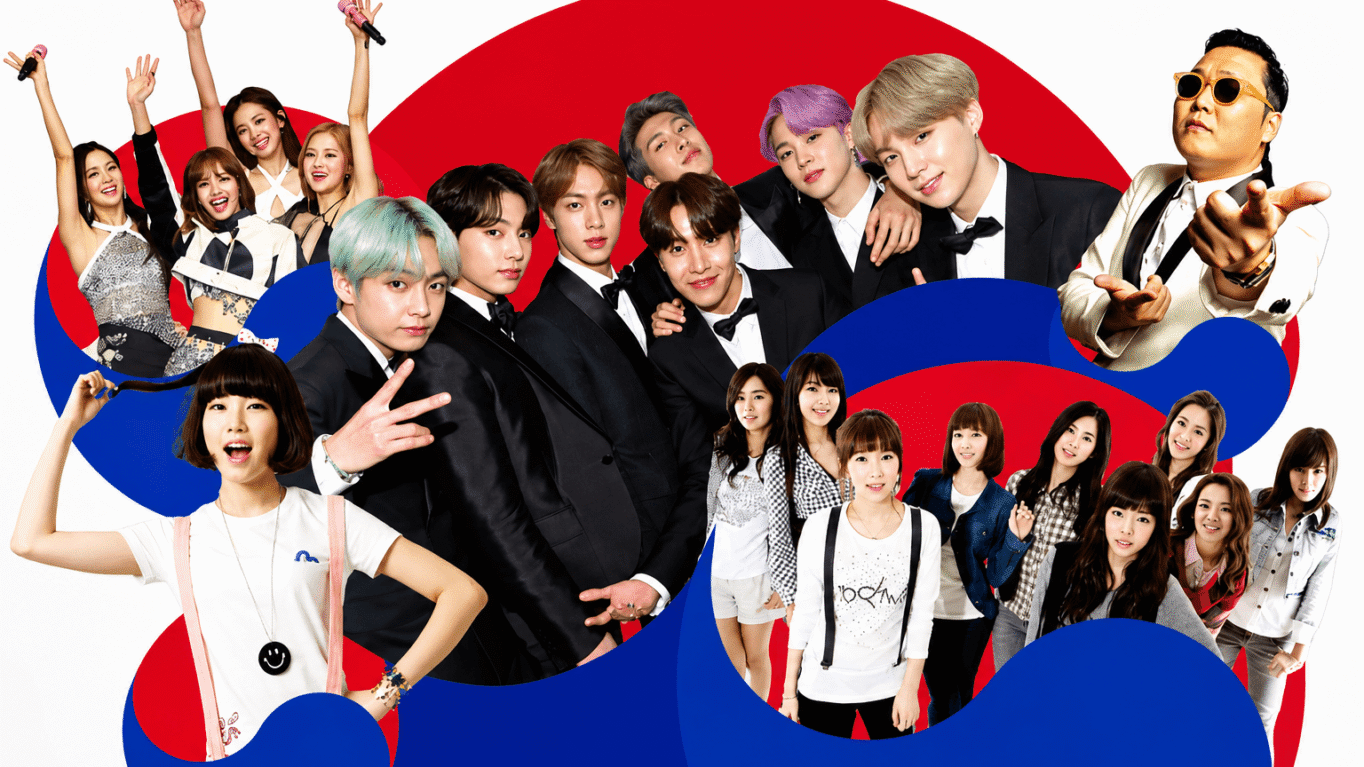
K-pop has always been a genre in translation. Long before BTS stepped onto the AMA stage in 2017, The Kim Sisters were performing American pop songs phonetically for Ed Sullivan’s audience in the 1950s, note-perfect in a language they didn’t yet speak. That original act — borrowing a foreign sound and returning it transformed — turns out to be the genre’s founding logic, not a phase it moved past. What’s changed isn’t the impulse to translate. It’s the direction the translation now runs.
The idol model was built for control. From H.O.T. in 1997 through the second generation of TVXQ and BIGBANG, K-pop’s innovation wasn’t musical — it was structural. Entertainment companies scouted, trained, and packaged performers years before debut, engineering vocals, choreography, and visual concept as a single product. The genre borrowed freely — hip-hop choreography, American pop hooks, R&B vocal runs — but Korean language and company control stayed non-negotiable. The sound could be anything. The system stayed closed.
That closed system is now the thing under pressure. CNN’s coverage of what analysts call K-pop’s “fifth generation” describes groups debuting outside Korea entirely, some with members who have no ties to the country, and BLACKPINK releasing a 2026 mini-album almost entirely in English. The question industry watchers are now asking plainly — does K-pop need to be Korean at all? — would have been unthinkable to the genre’s architects. The first generation exported a Korean product to the world; the current one is asking whether “Korean” was ever the essential ingredient, or just the accident of where the factory happened to be built.
Activism was once a subplot; now it’s part of the brand. Kim Min-ki’s 1970 protest song Morning Dew got him banned from Korean airwaves. BTS speaking against anti-Asian hate in 2021 got them a UN address and a Time cover. Same impulse, opposite consequence — because the audience, and the leverage that audience has, changed completely. A genre that once had to smuggle politics past state censors now has fans organized enough to shape hashtags and donation drives at global scale. The message didn’t get louder. The platform underneath it did.
Discovery has flipped from gatekept to self-selecting. Second-generation K-pop grew through regional TV and radio deals in China, Japan, and Southeast Asia — expansion required institutional partners. Third-generation K-pop broke into the U.S. because TikTok and Instagram let fandom route around those gatekeepers entirely. What’s notable in 2026 coverage is how far that logic has been pushed: songs are reportedly getting shorter while repeat-listen rates climb, structured deliberately around fifteen-second virality rather than the traditional single-and-b-sides arc. The platform isn’t just distributing the music anymore. It’s shaping how the music is written.
And the genre-blending that once made K-pop distinctive may now be dissolving its edges. The whole pitch of K-pop was synthesis — hip-hop, EDM, R&B, filtered through a specifically Korean pop sensibility. In 2026, commentary increasingly asks whether that filter still does anything: tracks charting highest are described as barely distinguishable from straight hip-hop or EDM. If the genre’s identity was always the *blend* rather than any one ingredient, what happens when the blend starts sounding just like its source material?
The through-line, then, isn’t K-pop becoming less Korean, or more global, or more corporate. It’s a genre whose entire mechanism — take something foreign, refine it inside a tightly controlled system, sell it back out — is now running in reverse. The system built to import and repackage foreign sound is exporting a product so thoroughly globalized that its country of origin has become optional. That’s not a genre in decline. It’s a genre discovering that the thing it was built to do so well — absorb an outside influence and make it unmistakably its own — has finally been turned on itself.