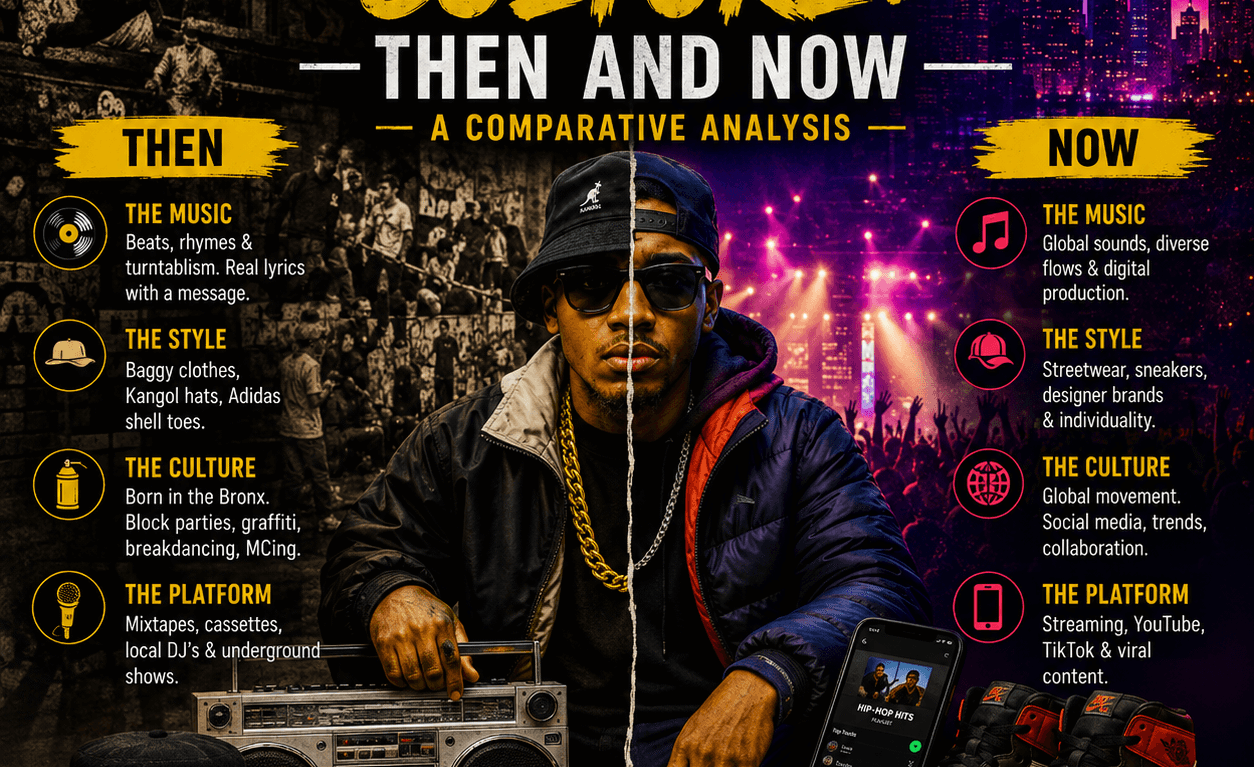
American hip-hop culture, 2000s–2010s:
The genre evolved in phases: creative dominance shifted to the American South (OutKast, Cash Money/No Limit, “Dirty South” sound) → producers took center stage (Dr. Dre, Timbaland, the Neptunes, Pharrell) → hip-hop became fully embedded in pop culture and business (Jay-Z, Kanye West, Beyoncé) → the internet decentralized the industry (SoundCloud rap, mumble rap, Cardi B and Doja Cat building fanbases on social media) → the genre went fully global (UK grime, Canadian rap, Latin trap, K-pop crossover). Through it all, the story is one of outward expansion — hip-hop absorbing new markets, new tools, and new geographies while staying centered on a handful of dominant American figures.
Hip-hop culture in 2026:
- Fragmentation over centralization. Instead of a single dominant sound or scene, 2026 hip-hop splits into fast-moving micro-genres — the “rage” sound pioneered by producers like F1lthy and Destroy Lonely, alongside drill evolutions, lo-fi revivals, and psychedelic rap.
- Global influence flows both ways. Rather than hip-hop simply spreading outward, sounds from Lagos, Seoul, London, and São Paulo now shape American trends as much as they’re shaped by them.
- Women hold structural power, not just visibility. Female artists now headline major festivals, dominate streaming charts, and control their own creative direction — a shift from earned individual stardom to systemic presence.
- AI is now a production tool, not just a talking point. AI is becoming integrated into music creation and discovery — assisting with composition, texture generation, and mixing.
- Fashion has cycled backward. Baggy denim and Y2K aesthetics are resurging — a nostalgia loop rather than continuous forward evolution.
- Discovery has matured past SoundCloud. Short-form video (TikTok, Instagram, YouTube) is now the primary virality engine, extending the DIY logic SoundCloud pioneered.
The core shift: The earlier era reads as a story of expansion around fixed centers — the South, then the internet, then the globe, but always anchored to a few dominant figures and a linear arc. The 2026 picture is one of convergence without a center — genre lines blur, global scenes co-create rather than follow, and technology (AI, short-form video) accelerates turnover so fast that, as one production analysis put it, sounds that dominate in January feel dated by June. Hip-hop hasn’t lost influence — if anything it’s more embedded in fashion, sports, and marketing than ever — but its center of gravity has become distributed rather than singular.