Every few years, the internet convinces itself that some dormant sound and its accompanying wardrobe are back from the dead. Usually that’s an overstatement — a trend cycle repackaged as a resurrection. But 2026 is a genuinely strange year for music subcultures, because several of them are surging at once instead of taking turns. Emo is pulling in teenagers who weren’t alive for its first run. Hyperpop, rather than fading like a lot of people predicted, has quietly become a production toolkit that mainstream pop borrows from constantly. Y2K aesthetics have outlasted every “it’s over now” think piece written about them since 2022. And underneath all three, smaller, stranger micro-scenes are incubating in Discord servers and SoundCloud pages, waiting to be the next thing a TikTok trend blows up overnight.
None of this is coincidental, and it’s part of a broader shift in how music culture functions right now — one we cover in more depth in our guide to music culture in 2026. Subcultures used to move in roughly generational waves, because they needed physical infrastructure — record stores, all-ages venues, MTV airtime — to spread. That infrastructure created scarcity, and scarcity created distinct eras: you had your grunge years, then your emo years, then your EDM years, mostly in sequence. Streaming and short-form video removed the scarcity. Every aesthetic that ever existed is now sitting in the same algorithmic pile, available to be rediscovered by a 16-year-old at 11 p.m. with the same ease as this week’s new single. The result is a kind of simultaneous nostalgia — multiple “revivals” running in parallel because nothing ever fully leaves circulation anymore.
Emo’s Second Wind, Powered by Kids Who Weren’t There the First Time
The emo revival isn’t a rumor at this point; it shows up in the numbers. Streaming data out of Germany’s music industry body, BVMI, has shown double-digit year-over-year increases for emo and pop-punk streams heading into 2026, and the #emo tag on TikTok has racked up billions of views as the aesthetic gets rediscovered by an audience mostly too young to remember the genre’s 2000s peak. The sound itself hasn’t drifted far from the source material — fast, layered guitar riffs, group-shout vocal hooks, and lyrics that lean directly into anxiety and heartbreak rather than dancing around it — but the delivery mechanism has changed completely. Instead of a burned CD passed around a school hallway, a track spreads because it works as fifteen seconds of a fan edit or a “get ready with me” backing track.
The visual identity has come back just as intact as the sound: skinny (or slouchy) jeans, heavy eyeliner, band tees, and Chuck Taylors are all back in rotation, worn now by a generation discovering the look secondhand rather than living through it the first time. That crossover between sound and wardrobe is exactly why subculture revivals rarely stay contained to music — we dig into the broader clothing side of this moment in our piece on 2026’s music and fashion trends. What’s genuinely different this time around, rather than just recycled, is the tone: today’s emo-adjacent fan spaces talk openly about mental health, and Discord servers built around the scene increasingly function as informal peer-support communities, not just fan clubs. It’s worth being careful about the word “informal” there — these spaces aren’t therapy and don’t claim to be — but the shift toward openly naming anxiety and depression, rather than just aestheticizing sadness, marks a real change from the genre’s first era.
Live events are part of the story too, in an uneven way. The genre’s flagship nostalgia festival circuit has grown enormously since the mid-2020s, to the point that at least one marquee emo/pop-punk festival is reportedly sitting out 2026 as a planned hiatus after several years of rapid expansion, with organizers already signaling a return the following year. That’s less a sign of the revival cooling off than of an event that scaled almost too fast to sustain every year — a very 2020s problem for a very 2000s genre to have.
Hyperpop Never Left — It Just Stopped Being Underground
If emo is a genre coming back, hyperpop is a genre that arguably never went anywhere; it just changed what “hyperpop” means as an audible presence. The style traces back to London’s PC Music collective and to acts like 100 gecs, who pushed pitch-shifted vocals, bitcrushed drums, and jarring tempo changes into a genre of their own in the late 2010s. What’s happened since is that those same techniques — the glitch stutters, the deliberately “wrong” transitions, the maximalist Auto-Tune — have leaked out of the underground scene and into mainstream pop production more broadly. Producers working well outside anything you’d call hyperpop now reach for those tools as ordinary hooks and transitions, the same way trap hi-hats became a default setting in pop a decade ago.
Part of what’s driving that is the platform economics of short-form video: songs that include some kind of sonic “disruption” — an unexpected pitch jump, a beat drop that arrives a half-second early, a texture that sounds broken on purpose — tend to hold attention better in a feed built around instant skips. Genuine hyperpop acts are still making music aimed squarely at that underground audience, but the sound’s DNA is now diffused well beyond it, which is a strange kind of victory for a genre that started as a deliberately abrasive reaction against polished pop.
Y2K’s Long Tail, and the Rise of Sigilkore
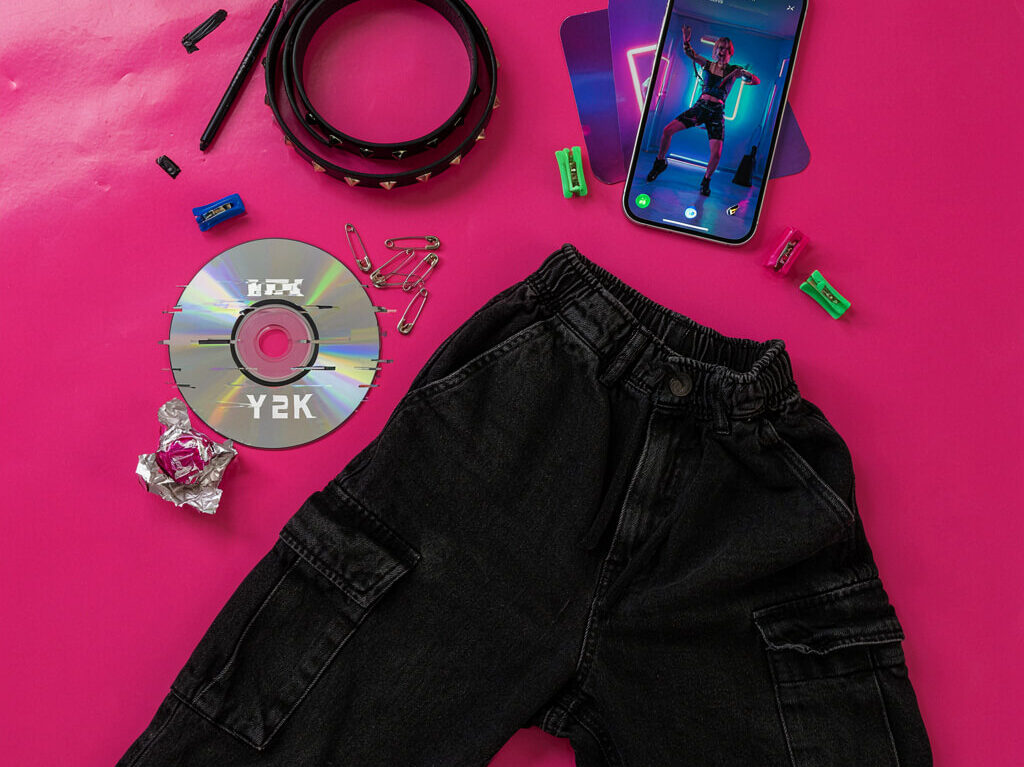
Y2K is the aesthetic that refuses to have an expiration date. On the fashion side it never fully receded — low-rise silhouettes, metallics, chunky tech accessories, and butterfly motifs have cycled in and out of relevance for a few years now, amplified heavily by K-pop and J-pop styling, which has pushed the look (sometimes rebranded “Y3K”) even further into the mainstream across East Asian pop markets and, from there, back into Western feeds. On the music side, the aesthetic’s modern reference point traces largely to the idea of “New Nostalgia,” a phrase associated with the 2020s wave of artists who blended 2000s pop and UK garage textures into something that sounds simultaneously old and new — glossy, a little lo-fi, built for headphones rather than radio.
What’s more interesting heading into 2026 is what’s growing in Y2K’s shadow: internet-native microgenres that borrow its maximalism but push it somewhere weirder. The clearest example is sigilkore, a style that emerged from cloud-rap and hexD roots in the late 2010s and fully broke out on TikTok in the early 2020s. It layers bitcrushed, pitch-shifted production over trap-adjacent drums, wrapped in occult-leaning visuals — sigils, GIF-editor aesthetics, deliberately lo-fi cover art — that read as a darker cousin to Y2K’s shinier nostalgia. It’s since splintered further into offshoots like krushclub, which fuses sigilkore’s crushed production with Jersey club’s rattling drum patterns. None of this is mainstream in the way emo or hyperpop currently are, but it’s exactly the kind of scene that tends to look, in hindsight, like the thing that was obviously about to break.
How Scenes Actually Spread Now, Versus Twenty Years Ago
The mechanics of scene-building have inverted almost completely. Twenty years ago, a subculture needed gatekeepers: a local scene built around all-ages shows, a MySpace page as your digital storefront, a spot on MTV’s rotation, message-board forums where the “rules” of an aesthetic got hashed out and enforced. Discovery was slow, and it was geographically clustered — a scene in one city could take months to reach another.
Now the whole process happens inside a handful of overlapping digital spaces, and we’ve written specifically about how that plays out on the platform that matters most in our piece on TikTok’s role in shaping 2026’s music trends. A new microgenre can incubate for months inside a small Discord server, tested and refined by a few dozen producers, before a single track breaks out as a sound trend on short-form video — often before most listeners ever consciously register it as a “song” they’re choosing to stream. Niche algorithmic playlists do the work forums used to do, sorting listeners into sub-scenes with uncanny precision. Fan edits function as the new mixtape and the new flyer at once, doing promotional work no label budget could replicate. The upside is speed and reach; the downside is that scenes now form and fragment faster than the old infrastructure — magazines, festivals, dedicated radio blocks — can really catch up to them.
What’s Next
If the current pattern holds, expect fragmentation to keep accelerating rather than settling into one dominant “next big subculture.” Watch adjacent revivals gaining real momentum outside this piece’s core three: nu-metal is having a genuine resurgence among younger listeners discovering acts like Deftones and Limp Bizkit through short clips rather than nostalgia, with touring plans for 2026 and 2027 already reflecting the demand. Expect the underground microgenre pipeline — the sigilkore-to-krushclub type of lineage — to keep producing at least one new named aesthetic every few months, most of which will stay niche and one or two of which will break wide the way phonk did. And don’t be surprised if a countercurrent builds against all of this maximalism: there’s a real appetite forming for stripped-down, “organic”-sounding music as a reaction to years of hyper-processed, algorithm-optimized production — a quieter subculture of its own, defined mostly by what it’s refusing to do. Whatever shape it takes, the underlying story stays the same: in 2026, no aesthetic ever really dies, it just waits for the algorithm to bring it back around.