From vinyl’s billion-dollar comeback to AI-made hits and TikTok’s grip on the charts — a complete guide to how music culture is shifting in 2026.
Something strange is happening to music culture right now, and it doesn’t fit the usual “everything is going digital” narrative. In the same year that AI-generated tracks are racking up millions of streams and sparking boycotts, teenagers are also queuing outside record stores for Record Store Day drops, buying turntables their parents gave up decades ago, and building entire identities around cassette tapes and CD binders. Culture isn’t just fragmenting into a thousand micro-scenes anymore — it’s fragmenting and converging at the same time, often within the same fanbase, sometimes within the same person.
Look closely and the contradiction makes sense. The more frictionless and automated listening becomes, the more some fans crave something they can hold, curate, and control. The more algorithms decide what plays next, the more a vocal segment of listeners — especially Gen Z — pushes back and goes looking for human taste-makers instead. Music culture in 2026 isn’t one story. It’s at least six overlapping ones: a physical-format revival, a quiet rebellion against algorithmic feeds, a genuine culture war over AI, TikTok’s ongoing reign over what becomes a “hit,” a wave of subculture nostalgia, and a fashion industry that can’t stop borrowing from all of it. This guide walks through each one.
Vinyl and Physical Formats Are Having a Real Moment, Not a Nostalgia Blip
It’s tempting to write off vinyl’s comeback as a fad that should have died out years ago. It hasn’t. Industry data from the first half of 2026 shows vinyl sales climbing again — roughly 16% year-over-year growth, with the pace actually accelerating in the second quarter compared to the first. That puts vinyl on track for its 19th consecutive year of growth, a streak that started back when streaming was supposed to have killed physical media for good. Vinyl is now closing in on CDs in unit sales, something that would have sounded absurd a decade ago.
CDs, meanwhile, aren’t fading quietly either. While CD units are still declining year-over-year, the rate of decline has been shrinking quarter over quarter in 2026, suggesting the format has found a floor rather than a grave. Combined physical album sales — vinyl and CD together — are up for the year, which is a genuinely unusual thing to be able to say in an era when nearly all listening happens through a phone.
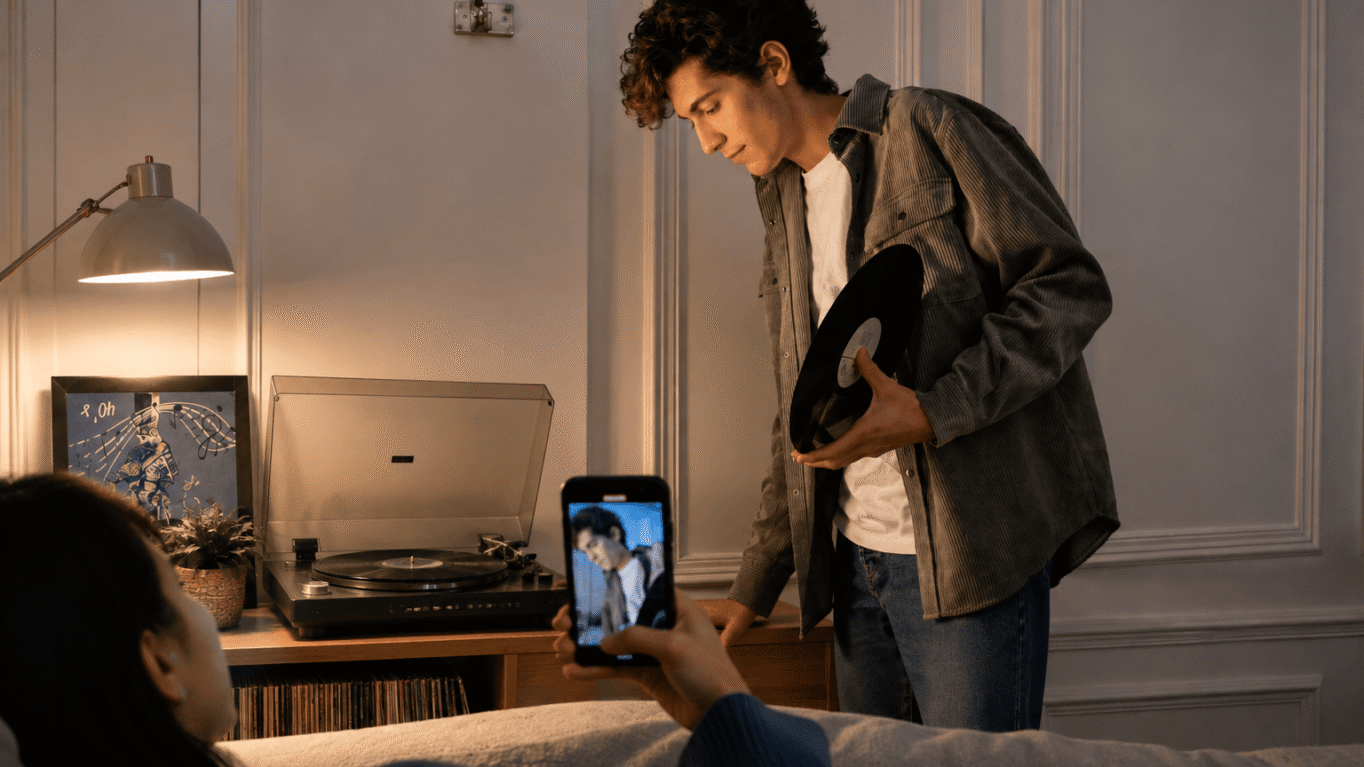
What’s driving it isn’t just collectors chasing rare pressings. It’s younger fans who never owned a record player before, buying vinyl as much for the ritual and the object as for the sound. A record needs a place in a room. It demands you sit with an album front-to-back instead of skipping after fifteen seconds. In a culture saturated with infinite, disposable digital content, that friction has become the appeal, not the obstacle.
This isn’t a side story — it’s arguably the most concrete evidence that the digital listening model, however convenient, isn’t meeting every emotional need fans have. For the full breakdown of what’s fueling the numbers and where the format is headed next, dig deeper into vinyl’s comeback.
Gen Z Is Getting Tired of Letting the Algorithm Decide
For most of the streaming era, the story was that algorithms won. Personalized playlists, autoplay queues, and “for you” feeds trained a generation to expect music to simply arrive, chosen for them, with zero effort. In 2026, that story is getting more complicated. There’s a growing, well-documented sense of algorithm fatigue among younger listeners — a feeling of being overwhelmed and, paradoxically, bored by systems built entirely to keep them engaged. When every recommendation is optimized for maximum retention, a lot of listeners report that everything starts to sound the same.
The response isn’t a wholesale rejection of technology — Gen Z still discovers plenty of music through apps — but it is a meaningful shift toward wanting a human hand back in the process. Interest in curated, non-algorithmic spaces is climbing: college and community radio, small independent playlists run by actual people, DJ sets, and word-of-mouth recommendations from friends or niche online communities. The underlying logic is simple. In a landscape absolutely flooded with content, trust starts to matter more than volume. Knowing that a real person with real taste picked a song for a reason carries more weight than knowing a model predicted you’d have a 71% chance of not skipping it.
This shows up in small cultural signals too: the return of the mixtape-as-concept (even if it’s a shared playlist now), the rise of niche Discord servers and group chats functioning as genre gatekeepers, and a renewed appreciation for magazine-style music writing and taste-driven curation over pure data. It’s less a rejection of Spotify and more a rejection of being passively fed — Gen Z increasingly wants to feel like they found something, not that something found them.
That distinction — between discovery that feels earned and discovery that feels manufactured — is becoming one of the defining fault lines in how young listeners relate to music platforms. To understand exactly how this generational shift is playing out and what it means for artists trying to break through, see how Gen Z is rejecting algorithmic discovery.
The AI Music Culture War Has Fully Arrived
If 2023 and 2024 were the years AI music went from novelty to threat, 2026 is the year the industry started fighting back in earnest — and fans picked sides. The flashpoint that keeps getting referenced is the case of an AI-generated band that quietly racked up millions of streams before listeners realized no actual musicians were behind it. That controversy didn’t stay contained; it became a symbol for a much bigger anxiety about authenticity, labor, and trust in an industry already stretched thin for working musicians.
The platforms have responded. Spotify began rolling out “AI Persona” labels in 2026 to flag artist profiles that are artificially generated rather than run by real people, with those flagged profiles losing access to algorithmic and editorial playlist placement — meaning AI acts can still exist on the platform, but they can no longer benefit from the same discovery machinery that boosts human artists. Apple Music has moved in a similar direction. It’s a meaningful policy shift, treating AI disclosure less like a courtesy and more like a structural requirement for participating in the ecosystem’s promotional tools.
Artists themselves haven’t stayed quiet either. Prominent musicians have publicly criticized both the flood of AI-generated tracks clogging playlists and the sloppier byproducts of AI integration on streaming platforms, from inaccurate AI-written artist bios to low-effort AI tracks competing for the same limited royalty pool as human musicians. There’s real money at stake: every stream an AI-generated song earns is, in a fixed royalty pool, a stream a working musician doesn’t get. That’s the economic core of the “culture war” framing, even before you get to questions about creativity, authorship, and what “real” music even means anymore.
Interestingly, early signals suggest listener enthusiasm for AI-generated music is cooling, particularly among younger audiences who tend to prize authenticity and artist story as much as the song itself. Whether that holds as the technology gets better and harder to detect is one of the biggest open questions in music culture right now. For a full breakdown of the flashpoints, the platform policies, and where artists and fans are drawing lines, explore the AI music culture war.
TikTok Still Decides What Becomes a Hit — But the Relationship Is Evolving
Nobody seriously questions TikTok’s power over the charts anymore; the data makes it hard to argue otherwise. A large majority of songs that break into the major global charts do so after going viral on TikTok first, not the other way around. Multiple recent Billboard No. 1 hits can be traced back to a TikTok moment — a sound bite, a dance trend, a meme format — before they ever became radio or playlist hits. TikTok users are also measurably more likely to discover and share new music than users of other short-form video platforms, and the app’s built-in save-to-streaming tools convert that attention into actual plays at scale, funneling billions of track saves into services like Spotify and Apple Music every year.
For independent and emerging artists, TikTok has effectively become the new A&R department. Surveyed independent creators increasingly rank it as their single most important platform for growth — ahead of Spotify, ahead of Instagram, ahead of YouTube. A 15-second clip landing with the right sound can now do more for an unknown artist’s career than a traditional label deal used to.
But “TikTok breaks songs” in 2026 looks different than it did a few years ago. Labels and artists have gotten more strategic and, in some cases, more cynical about engineering virality on purpose — pre-planning a “TikTok moment” into a song’s structure before it’s even released, rather than waiting for an organic clip to catch fire. That’s shifted some listener goodwill; there’s a growing wariness around songs that feel manufactured for quick, out-of-context virality rather than built to hold up as a full listen. The platform’s influence hasn’t shrunk, but the culture around it is maturing, and artists who lean on it too obviously risk a backlash.
This dynamic — equal parts opportunity and trap — is reshaping how songs get written, released, and marketed. For a deeper look at how TikTok’s role in the industry is shifting in 2026, read more on TikTok’s evolving role in breaking songs.
Subculture Revivals Are Back: Emo, Hyperpop, and Y2K All at Once
Music subcultures used to arrive one at a time, roughly a generation apart. In 2026, they’re arriving in a pile-up. Emo is having a full-throttle resurgence — not as ironic nostalgia, but as a genuinely active scene, with new artists drawing on 2000s emo’s sound and aesthetic while festival lineups and underground scenes (particularly in the UK) blend old emo signifiers with newer, harder-edged influences. Hyperpop, meanwhile, has moved from internet-only niche to a recognizable influence across mainstream pop production, its glitchy, maximalist DNA showing up in tracks that have nothing to do with the original scene. And Y2K aesthetics — low-rise everything, butterfly clips, chunky sunglasses, bubblegum production — have been steadily colonizing both playlists and closets since the early 2020s and show no sign of slowing down in 2026.
What’s notable is that these aren’t sequential trends replacing one another; they’re running in parallel, often pulling from the same listener base. A single Gen Z fan might be deep in an emo-revival Discord, following hyperpop producers on SoundCloud, and dressing head-to-toe Y2K for a night out — all without any sense of contradiction. Culture commentators have started calling 2026 something close to a full “subculture revival” moment, where multiple aesthetic movements are being resurrected and remixed simultaneously rather than one dominant youth culture taking over.
Part of what’s fueling this is access. Kids who weren’t alive for the original emo or Y2K eras can now binge an entire subculture’s back catalog, message boards, and archived fashion in an afternoon, compressing what used to take years of scene immersion into a weekend deep-dive. Nostalgia isn’t inherited slowly anymore — it’s downloaded.
The result is a genuinely strange, layered cultural moment where several “revivals” are happening on top of each other. For the full picture of which scenes are coming back, why now, and what’s next, dig into the subculture revivals shaping 2026.
Music and Fashion Are Feeding Each Other Faster Than Ever
Music and fashion have always fed off each other, but the loop has never spun this fast. Festival season now functions as an unofficial runway, with Gen Z’s appetite for nostalgia openly shaping festival fashion trends — denim, Y2K throwbacks, and archive-inspired looks are showing up on festival grounds as much as on runways. Streetwear brands are leaning harder into music-driven collaborations, with hip-hop and pop artist partnerships continuing to define what counts as “of the moment” in 2026 streetwear.
Concert merch has evolved too, moving well past the basic tour t-shirt into genuinely collectible fashion — limited-edition drops, poster art, and design-forward pieces that fans treat less like souvenirs and more like wardrobe staples. That shift mirrors the vinyl revival in an interesting way: fans want something physical and specific to prove they were part of a cultural moment, not just a digital receipt of a stream count.
The relationship also runs backward now — fashion doesn’t just borrow from music, it helps launch it. A distinctive artist look can go viral independently of the song attached to it, then pull new listeners in after the fact. Aesthetic-first discovery, where the outfit or the visual world of an artist hooks someone before the music does, has become a normal on-ramp rather than an exception, particularly on visually driven platforms.
None of this is new in kind, but the speed is new. A look can appear at a festival, get memed, get resold as merch, and show up in fast fashion within weeks. For a closer look at exactly how the two industries are accelerating each other in 2026, check out how music and fashion are feeding off each other.
What to Watch Next
Music culture in 2026 doesn’t resolve into a single trend line — it’s several tensions playing out simultaneously, and none of them look close to settling. A few threads worth keeping an eye on heading into next year:
- Whether physical formats keep climbing or plateau. Vinyl’s growth streak is remarkable, but at some point supply, pricing (vinyl now averages well over double the cost of a CD), and manufacturing capacity could cap how far it can keep scaling.
- How aggressively platforms enforce AI labeling. Spotify’s AI Persona system is new; whether it meaningfully curbs AI music’s reach — or just pushes it further underground — will shape the next round of the authenticity debate.
- Whether Gen Z’s pull toward human curation turns into real business models. Independent radio, curated playlists, and niche taste-making communities are gaining attention, but it’s unclear whether that translates into sustainable platforms or stays a countercultural niche.
- Which subculture wins the mainstream tug-of-war. Emo, hyperpop, and Y2K are all circulating at once; expect at least one to break further into pop’s center of gravity while the others stay more scene-specific.
- Whether TikTok-engineered virality starts to backfire. As listeners get more attuned to songs built for a viral moment rather than a full listen, there’s real risk of fatigue setting in around that specific style of song construction.
Taken together, these threads point to a music culture that’s less about one dominant format or platform winning and more about listeners actively choosing — sometimes several contradictory things at once — what kind of relationship they want with the music in their lives. That push and pull, between automation and authenticity, between digital convenience and analog ritual, is likely to be the defining story of music culture for the rest of the decade.