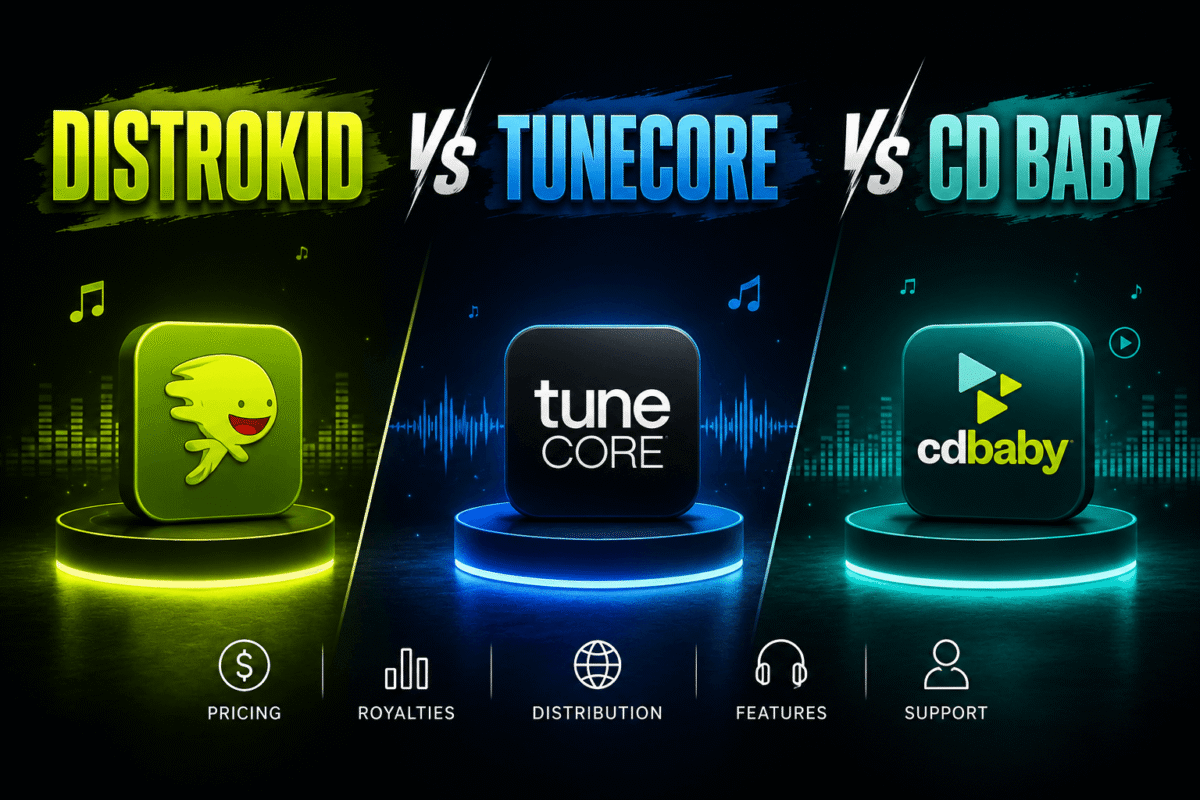
Choosing a distributor is one of the first real business decisions you’ll make as an artist, and it has long-term consequences. Here’s how the three most popular options compare in 2026, and how to pick the one that suits how you actually release music.
Note: distributor prices change often — DistroKid raised its prices during 2026 — so treat the figures below as a current snapshot and confirm them on each company’s site before you commit.
First, what a distributor does
Spotify, Apple Music and the other platforms don’t accept uploads directly from individual artists. A distributor delivers your music to all of them from one upload, assigns your ISRC and UPC codes, and collects your recording royalties.
How to compare distributors
The headline price is rarely the real story. What actually matters is the pricing model (subscription vs one-time), the royalty split, whether your music stays up if you stop paying, and the add-on fees that quietly stack up.
The three biggest distributors
DistroKid
A subscription model built for people who release a lot. Plans start at around 24.99/year∗∗(Musician,oneartistname,unlimiteduploads),withMusicianPlusaround∗∗24.99/year∗∗(Musician,oneartistname,unlimiteduploads),withMusicianPlusaround∗∗44.99/year and an Ultimate tier around $89.99/year. You keep 100% of royalties. The trade-offs: several features are paid add-ons (YouTube Content ID, for example), and if you stop paying, your music is removed from stores within about a month unless you pay a one-time fee to keep each release up.
TuneCore
Now offers tiered annual plans, starting around 14.99/year∗∗andrisingtoroughly∗∗14.99/year∗∗andrisingtoroughly∗∗50/year for its top tier. You keep 100% of your recording royalties, and it offers publishing administration as an add-on (it takes a percentage of publishing it collects). Like DistroKid, it’s subscription-based, so your music comes down if you stop renewing. Good fit if you want publishing admin bundled in.
CD Baby
The one-time model. You pay once per release (around $10 for a single, more for an album) and your music stays up forever with no renewals. In exchange, CD Baby keeps 9% of your royalties. Its Pro tier adds publishing administration. Best for artists who hate recurring bills and want their catalogue online permanently.
Pricing at a glance
| Model | Royalty cut | If you stop paying | |
|---|---|---|---|
| DistroKid | Subscription, ~$24.99/yr+ | 0% | Music removed (unless you pay to keep it up) |
| TuneCore | Subscription, ~$14.99/yr+ | 0% | Music removed |
| CD Baby | One-time, ~$10/release+ | 9% | Music stays up forever |
Which one should you choose?
If you release often
Four or more releases a year? A flat-fee unlimited subscription (DistroKid, or alternatives like Ditto) usually gives the lowest cost per release.
If you release rarely
One or two releases and you want them up permanently without thinking about it? CD Baby’s one-time fee is more predictable, and the 9% cut is negligible at low streaming volumes.
If you’re on a tight budget
Look at the cheapest qualifying tier rather than the headline. TuneCore’s entry plan and some free-tier distributors (like UnitedMasters or Amuse) can work when you’re just starting and earning very little.
Don’t forget publishing royalties
Whichever you pick, remember distribution only collects your recording royalties. Either use the distributor’s publishing add-on or a separate publishing administrator so you don’t leave publishing royalties unclaimed.
A red flag to watch for
A legitimate distributor never asks you to sign over ownership of your masters. If a “deal” includes language about transferring your copyright, it’s a label or licensing arrangement disguised as distribution — read it carefully.
Quick FAQ
- Can I switch distributors later? Yes — upload to the new one (reusing your existing ISRCs), confirm it’s live, then take the release down from the old one to avoid duplicates.
- Do any keep my music up for free? No mainstream distributor offers permanent free hosting; you either subscribe or pay a one-time fee.